The McKinsey Sea Wolf Game: A Complete 2026 Guide to Phases, Scoring, and Strategy
The McKinsey Sea Wolf game is the most analytically demanding module of the McKinsey Solve assessment. If you've received an invitation to take McKinsey's pre-interview screening test, Sea Wolf is one of the games you'll face — and how you perform on it will play a meaningful role in whether you advance to the McKinsey case interview stage.
This guide explains what the McKinsey Sea Wolf game is, how its five phases work, how scoring functions, how much time you'll have, and the most common mistakes candidates make. By the end you'll have a clear picture of what to expect on test day and how to prepare effectively.
What is the McKinsey Solve assessment?
The McKinsey Solve assessment — also known as the McKinsey Problem Solving Game, McKinsey Digital Assessment, or by its earlier name, the Imbellus assessment — is a cognitive screening test that McKinsey & Company uses to evaluate candidates before inviting them to case interviews. It replaced the older Problem Solving Test (PST) and is now a standard part of McKinsey's hiring process worldwide.
The Solve assessment is not a knowledge test. You do not need any background in biology, ecology, marine science, or business to perform well. It is a cognitive proxy designed to measure how you think — specifically, your ability to make sound decisions with incomplete information under significant time pressure while managing multiple constraints simultaneously. Those are the same cognitive demands you'll face as a McKinsey consultant on a real engagement, which is why the assessment exists.
As of 2026, the McKinsey Solve assessment consists of two core games for most candidates:
- Redrock Study (35 minutes) — a data interpretation and case study exercise
- Sea Wolf (30 minutes) — the microbe-selection optimisation game covered in this guide
A third module called the Sustainable Futures Lab (SFL) has been introduced in some regions and adds approximately 20 minutes to the assessment, bringing the total to 85 minutes instead of the standard 65. Check your invitation email — if it says 65 minutes, you have only Redrock and Sea Wolf. If it says 85 minutes, you'll also face the Sustainable Futures Lab.
For a full breakdown of the assessment structure, format changes over the years, and what to expect on test day, see our McKinsey Solve 2026 — what's changed and what to expect.
What is the McKinsey Sea Wolf game?
The McKinsey Sea Wolf game — sometimes called the Ocean Cleanup game, the Ocean Treatment game, the microbe game, or simply Sea Wolf — is a 30-minute interactive simulation in which you visit three polluted ocean sites and develop a treatment for each one by selecting the right combination of microbes.
Each microbe in the game has five characteristics:
- Three numerical attributes, each measured on a scale from 1 to 10
- One trait, drawn from a small set of biological properties
Each contamination site has its own requirements. The site specifies a target range for each of the three attributes (always a 2-point-wide range, such as 1–3, 4–6, or 8–10) plus one desired trait and one undesired trait. Your job is to select microbes whose combined profile best satisfies the site's requirements.
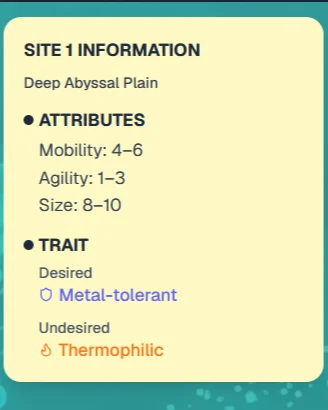
Each site specifies target ranges for three attributes plus one desired and one undesired trait.
The Sea Wolf game tests several cognitive skills simultaneously:
- Quantitative reasoning — you'll be averaging numbers, evaluating ranges, and balancing constraints almost continuously
- Decision-making under uncertainty — you'll often have to make choices without complete information
- Working memory — you'll need to hold multiple variables in your head at once while making each decision
- Time management — the 30-minute total budget across three sites is tight, and most candidates struggle to finish without practice
- Pattern recognition — recognising the structure of a good versus bad microbe profile quickly is the difference between passing and failing
Sea Wolf is widely considered the most quantitative module in the McKinsey Solve assessment. Candidates with strong analytical backgrounds often find Redrock more intuitive but Sea Wolf more punishing — the tight time budget makes it unforgiving of inefficient decision-making.
How is the McKinsey Sea Wolf game structured?
The Sea Wolf game takes place across three contamination sites, played sequentially. Each site is a complete scenario with its own attribute ranges, desired trait, and undesired trait. The 30-minute timer is shared across all three sites — there are no per-site sub-timers — which means how you allocate your time between sites is entirely your decision.
Each site is composed of five phases. The phases are numbered 0 through 4, which can be confusing — Phase 0 is named that way because it does not appear at Site 1.
- Phase 1 — Profiling
- Phase 2 — Categorization
- Phase 0 — Review (Sites 2 and 3 only)
- Phase 3 — Prospect Pool
- Phase 4 — Treatment
The phases at Site 1 run in the order: Phase 1, Phase 2, Phase 3, Phase 4. Sites 2 and 3 add Phase 0 at the start: Phase 0, Phase 1, Phase 2, Phase 3, Phase 4.
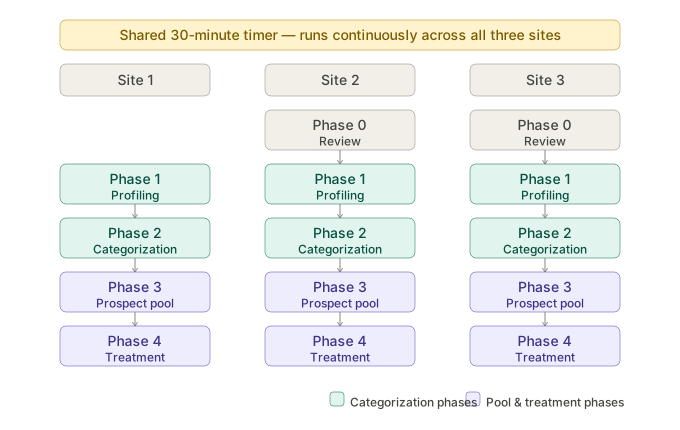
The phase sequence per site. Phase 0 only appears at Sites 2 and 3.
Phase 1 — Profiling
In Phase 1, you're shown the site's requirements and asked to select two characteristics from a menu of seven options: the three attributes (each with a slider where you choose a value range) and the four traits.
This phase asks you to demonstrate that you've correctly read the site's profile. It's the simplest phase mechanically, and your performance here doesn't influence which microbes appear in later phases — it's scored independently.
Phase 1 typically takes well under a minute once you're familiar with the interface.
Phase 2 — Categorization
In Phase 2, you're shown ten microbes one at a time. For each, you decide whether to keep it at the current site, send it forward to the next site, or return it to the source.
At this point in the game, you have full information about the current site but only one revealed clue about the next site — either one of its three attribute ranges or one of its traits. That asymmetric information is what makes Phase 2 challenging.
At Site 3, the "send to next site" option disappears, because there is no next site. Every Phase 2 decision at Site 3 becomes a binary keep-or-return choice.
You can reassign any microbe at any point during the phase, and the game shows you a confirmation screen before moving on, giving you a chance to review your decisions.
Phase 0 — Review
At Sites 2 and 3 only, Phase 0 begins with the microbes that the previous site categorised as "next site" candidates. Now that you have full information about the current site, you revisit those microbes and decide whether to keep them or return them.
Phase 0 doesn't introduce new microbes — it only re-evaluates microbes you already categorised once. As with Phase 2, you can reassign before the final confirmation screen.
Phase 3 — Prospect Pool
In Phase 3, you build the pool of microbes you'll select from in the final phase. You start with six preloaded microbes already in your pool. Across four rounds, you're shown three candidate microbes per round and pick one to add to your pool. After all four rounds, your pool contains 10 microbes.
The microbes you choose in Phase 3 flow directly into Phase 4 — they are the only microbes you can select from in the final treatment phase. This makes Phase 3 strategically significant: the quality of your eventual Phase 4 score is capped by the quality of the pool you build in Phase 3.
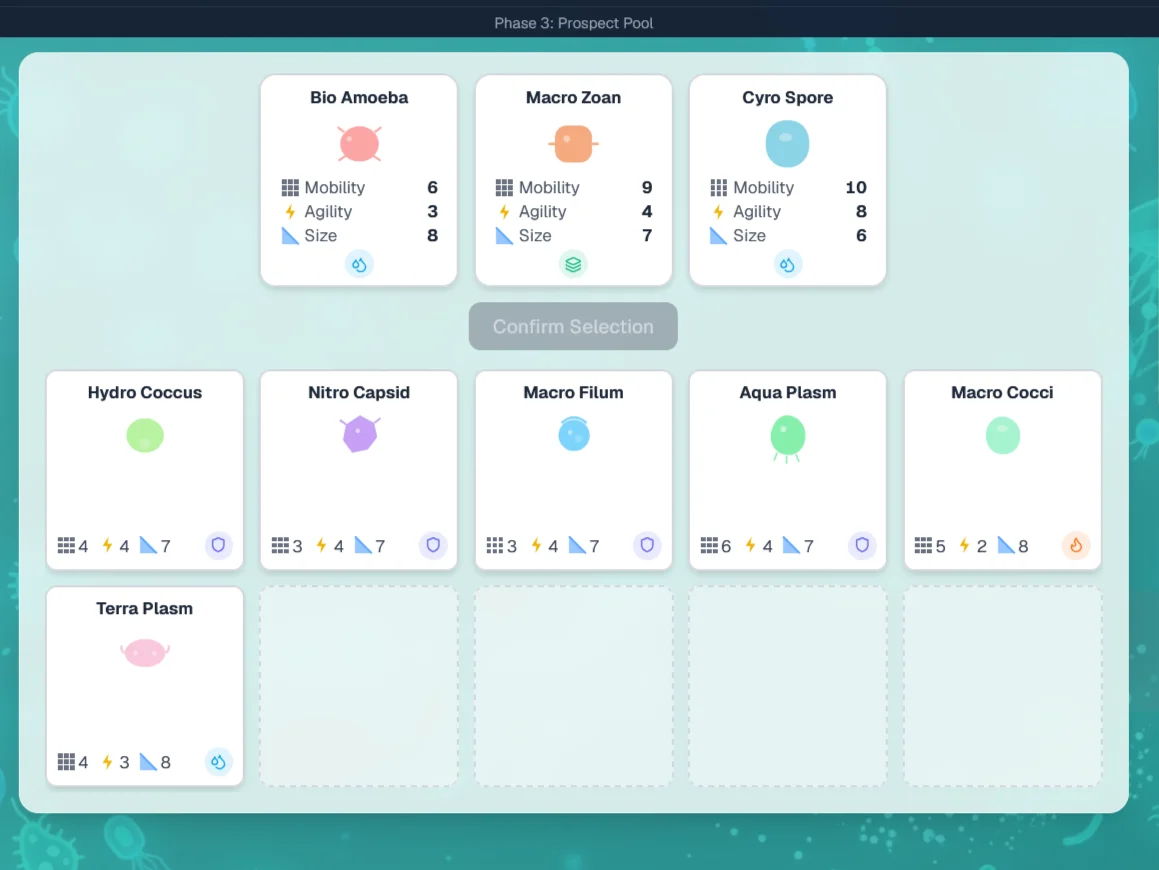
Each Phase 3 round presents three candidates — you pick one to add to your growing pool.
Phase 4 — Treatment
In Phase 4, you select three microbes from your pool of 10 to deploy as the treatment for the site. This is the only phase where your performance is graded against a formally disclosed scoring formula, and the only phase where your final score for the site is directly computed from the conditions your three-microbe selection satisfies.
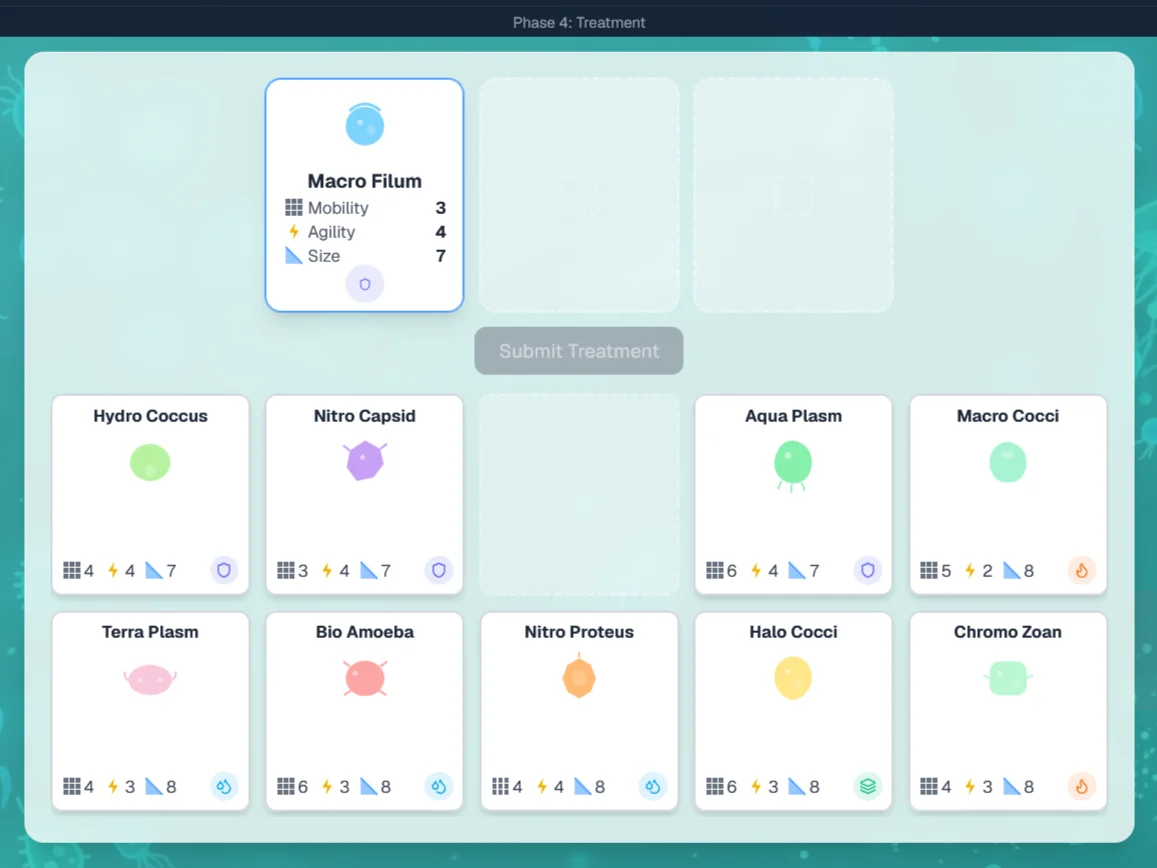
Phase 4: select the optimal combination of 3 from your pool of 10.
How is the McKinsey Sea Wolf game scored?
McKinsey discloses the scoring formula for Phase 4 but not for the other phases. Based on the official rules, your Phase 4 selection is evaluated against five conditions, each worth 20% of the phase score:
- The mean of the first attribute across your three selected microbes falls inside the site's target range.
- The mean of the second attribute across your three selected microbes falls inside the site's target range.
- The mean of the third attribute across your three selected microbes falls inside the site's target range.
- At least one of your three selected microbes has the desired trait.
- None of your three selected microbes has the undesired trait.
For a dedicated breakdown of how each condition is evaluated and what the scoring logic means in practice, see Sea Wolf scoring explained — the 5 conditions.
You start at 100% and lose 20% for each condition you fail. A perfect selection scores 100%. Missing one condition scores 80%, two conditions scores 60%, and so on.
The most important word in the scoring rule is mean. The attribute conditions evaluate the average across your three microbes, not each microbe individually. This is the single most strategically important fact in the entire Sea Wolf game, and we'll return to it below.
McKinsey has not publicly disclosed how Phases 1, 2, 0, and 3 are scored. What we know from candidate reports is that each phase is scored independently and your overall Sea Wolf score reflects performance across all phases at all three sites — not just Phase 4. Strong performance on the "softer" phases contributes meaningfully to your overall result.
What is McKinsey's behavioural score — and why it matters for Sea Wolf
Most candidates prepare for the McKinsey Solve as if it were a traditional test: answer correctly, score well. This is incomplete. McKinsey evaluates you on two dimensions simultaneously.
The first is the product score — the quality of your final decisions. In Sea Wolf, this is how well your microbe selections satisfy each site's conditions.
The second is the process score — how you arrived at those decisions. McKinsey's software tracks every interaction you have with the assessment: every click, every microbe you hover over, how long you spend on each decision, how often you change your mind, and the order in which you consider information. This behavioural data is used to infer how you think, not just what you decided.
McKinsey has never published the exact algorithm behind the process score, but candidate reports consistently point to a small set of behaviours that the scoring system rewards:
- Deliberate, structured decision-making. Moving through phases with a clear approach rather than clicking around exploratorily.
- Consistent strategy. Applying the same reasoning framework across microbes and rounds, rather than switching logic unpredictably.
- Efficient use of available information. Reading site requirements before making decisions, not after.
- Appropriate decisiveness. Committing to choices without excessive backtracking.
The implications for Sea Wolf are direct. If you know your strategy going in — how to evaluate microbes, what order to consider conditions, when to move on — your interaction patterns will naturally look structured and confident. If you're figuring it out in real time, the hesitation, backtracking, and inconsistency show up in the telemetry whether or not your final answer is correct.
Two candidates can select the same three microbes in Phase 4 and receive different overall scores, because the behavioural data from Phases 1 through 3 diverged. This is not widely understood, and it is one of the strongest arguments for practising with a realistic simulator before your real assessment date.
For a deeper look at how McKinsey's dual scoring system works across both Redrock and Sea Wolf, see our dedicated article: McKinsey's Behavioural Score Explained.
Can you always score 100% on a Sea Wolf site?
No, and this is a critical thing to understand before test day. Not every site is solvable to 100%.
The Sea Wolf game occasionally presents pools where, even with perfect Phase 4 play, no combination of three microbes can satisfy all five conditions. Sometimes the highest possible score on a site is 80%. Sometimes it is 60%. Candidates who expect 100% on every site and keep searching for a perfect combination that doesn't exist waste enormous amounts of time and often fail to finish the assessment.
The correct mindset is to recognise when a site won't go higher than its actual ceiling, take the best achievable score, and move on. Missing a 20% deduction on one site is far less costly than running out of time before completing another site at all.
How much time do you have for the McKinsey Sea Wolf game?
The Sea Wolf game has a 30-minute total timer shared across all three sites. There are no per-site sub-timers — you allocate time flexibly, and the clock runs continuously.
A useful rule of thumb is to aim for roughly 10 minutes per site as a soft maximum. If you find yourself going significantly over that at any site, the right call is almost always to make your best available decision and move on. The reasoning is simple: an imperfect score on one site is much better than an incomplete or unattempted score on the next one.
Most candidates report that Site 1 is the slowest because they're still adjusting to the interface and the game's logic. Speed typically improves substantially by Site 2, and Site 3 is often the fastest. Practising on a realistic Sea Wolf simulator before test day is the single most effective way to reduce Site 1's time cost — by the time you take the real assessment, the interface should feel familiar.
General Sea Wolf strategy tips
Below are general principles every Sea Wolf candidate should internalise. These won't substitute for thorough practice or a deeper strategic playbook, but they will help you avoid the most common mistakes.
Think in averages, not individuals
The most important strategic insight in the Sea Wolf game is that Phase 4 evaluates attribute averages across three microbes, not individual values. This has direct consequences for how you should evaluate microbes throughout the game.
A microbe with an attribute value far above the target range is not disqualified — it might be the perfect partner for a microbe whose value sits below the range, because the average of the two extremes could land in the middle. Candidates who reject microbes on the basis of individual values throw away viable combinations and dramatically reduce their score ceiling.
Train yourself to look at a pool and see numbers contributing to averages, not yes/no candidates on their own.
Use the sum-to-3×range arithmetic shortcut
A practical mental arithmetic technique that saves enormous time: instead of computing means and checking ranges, sum the three attribute values directly and check whether the sum lands in 3× the range.
If the site's target range for an attribute is 4–6, the sum of the three selected microbes' values for that attribute needs to land between 12 and 18 (i.e. 3×4 to 3×6). If the range is 8–10, the sum needs to be between 24 and 30. This avoids fractional arithmetic and makes range-checking essentially instantaneous.
For partial calculations — say you've chosen two microbes and need to figure out what the third needs to deliver — sum the two values, subtract from each end of the 3×range window, and you have the exact band the third microbe must fall into. This kind of mental shortcut is the difference between a calm Phase 4 and a panicked one.
Watch for "inviable" microbes
Some microbes are mathematically impossible to use successfully at a given site. If an attribute value is so far from the site's range that no two partners can pull the average back in, the microbe is dead weight at that site no matter what you pair it with.
This usually only happens when the site's range is at the extreme ends of the 1–10 scale — ranges of 1–3 or 8–10. At those extremes, learning to spot inviable microbes in seconds saves time across every phase. Don't waste cognitive effort considering a microbe that mathematically cannot work.
Be prepared to abandon your first pick
Candidates often fixate on the first promising microbe they identify and try to force a combination around it. This is one of the most expensive mistakes in the game. If a candidate-anchor microbe can't be paired with partners that satisfy the site's conditions, the right call is to drop it and start over — not to settle for an imperfect combination just because you've already committed mentally.
This applies in Phase 3 (picking candidates) and Phase 4 (selecting the final three). Be willing to start fresh. The cost of a 15-second reset is far smaller than the cost of a weak final selection.
Don't stack microbes with the same trait
A common candidate instinct is to load up on microbes with the desired trait — three with the desired trait must be better than one, right? Wrong. Phase 4 only requires that at least one of your three selected microbes has the desired trait. Beyond that one, the trait adds nothing to your score.
What matters is whether your three microbes collectively satisfy the attribute conditions. If you fill your pool with desired-trait microbes whose attribute values don't combine well, you'll find yourself unable to satisfy the attribute conditions in Phase 4, regardless of how many desired-trait microbes you have.
Manage the clock ruthlessly
This is worth repeating because it's the single most common cause of failure. The 30-minute timer is brutally tight for candidates who aren't practised. Spending too long on any one phase or site will leave you unable to complete the rest.
When in doubt, make a reasonable decision and move on. A confidently made 70% beats an agonised-over 90% that you never finish.
Practise on a realistic Sea Wolf simulator
The cognitive skills the Sea Wolf game tests are real skills that genuinely improve with practice. Candidates who walk in cold consistently underperform candidates who've practised on a realistic Sea Wolf simulator beforehand — not because the simulator teaches them the answers (there are no answers to memorise), but because it teaches them to navigate the game's pace and structure without burning cognitive bandwidth on the interface itself.
A good Sea Wolf simulator will offer multiple scenarios with varying difficulty, all five phases playable end to end, and post-run feedback so you can see where your decisions cost points. Some platforms also offer a Sea Wolf solver, which computes the mathematically optimal pool and treatment for any scenario — used during practice (not, obviously, during the real assessment), a solver is the fastest way to internalise what a good combination looks like.
The most common McKinsey Sea Wolf mistakes
To summarise, the most frequent errors that candidates make in the Sea Wolf game are:
- Filtering microbes by individual attribute values instead of thinking in averages
- Spending too much time on Site 1 and running out of time at Site 3
- Chasing 100% on a site where 100% isn't available
- Stacking microbes with the desired trait instead of building balanced combinations
- Refusing to abandon a flawed candidate once they've committed to it mentally
- Ignoring inviable microbes at extreme-range sites
- Failing to use mental arithmetic shortcuts like the sum-to-3×range technique
- Practising too little or with outdated materials that don't reflect the current 2026 game format
How to prepare for the McKinsey Sea Wolf game
Preparation for Sea Wolf benefits from focused, repeated practice more than from passive reading. The mechanics are simple enough to learn in an afternoon, but the speed and judgment required to play well only develop with reps on varied scenarios.
A reasonable preparation plan looks like:
- Read a structured guide once to understand the rules and scoring of each phase. Our full Sea Wolf strategy guide covers optimal play for each phase in detail.
- Play a Sea Wolf simulator end to end at least 5–10 times, ideally on different scenarios, to build interface familiarity and pacing.
- Review your decisions after each run — particularly your Phase 3 picks and Phase 4 final selection — to identify patterns in where you lose points.
- Use a Sea Wolf solver during practice only to learn what an optimal combination looks like for difficult scenarios. Compare your decisions to the solver's output to internalise the structure of good play.
- Practise time management explicitly by treating the full 30-minute clock as inviolable. Don't pause it during practice runs.
Candidates who follow this kind of structured plan consistently outperform candidates who walk in having only read about the game.
Related guides
- What is the McKinsey Solve assessment? — Complete 2026 overview
- McKinsey Redrock Study — Phases, scoring, and strategy
- McKinsey's behavioural score explained — what the process score actually tracks
- McKinsey Solve 2026 — what's changed and what to expect
- Sea Wolf strategy guide — optimal play for each phase (simulator access required)
Final thoughts
The McKinsey Sea Wolf game is a demanding cognitive test, but it is a learnable one. The mechanics are public, the strategy can be taught, and the time pressure that intimidates unprepared candidates becomes manageable with practice. What separates candidates who pass from candidates who don't is rarely raw intelligence — it's whether they walked into the assessment having practised the format, internalised the averaging mindset, and developed the time discipline the 30-minute timer demands.
If you have a McKinsey Solve assessment coming up, the most valuable thing you can do is treat Sea Wolf as a skill to train, not a test to cram for. The candidates who get to the McKinsey case interview stage are the ones who took it seriously, prepared deliberately, and walked in ready.