What is the McKinsey Solve Assessment? Complete 2026 Guide
If you've applied to McKinsey and received an email with a link to complete an online assessment, you've been invited to take McKinsey Solve. This guide explains exactly what it is, why it matters, how it's scored, and what to expect from the current 2026 format.
You may have seen it called the McKinsey Problem Solving Game (PSG), McKinsey Digital Assessment, or the Imbellus Game. These all refer to the same test.
What McKinsey Solve actually is
McKinsey Solve is a cognitive assessment — not a game, not a knowledge test, and not a measure of your business experience. It is a proxy for the kind of thinking McKinsey wants in its consultants: making sound decisions quickly, with incomplete information, while managing multiple constraints at once.
The scenarios are themed around ecology and marine science, but that's cosmetic. You don't need any background in biology, ecology, or business to perform well. McKinsey uses nature-themed simulations precisely because they level the playing field — no candidate has a meaningful knowledge advantage.
What the test actually measures is how you think. The underlying cognitive skills it targets — structured reasoning, quantitative fluency, decision-making under pressure — are the same ones you'll use daily as a McKinsey consultant. Solve was designed to surface those skills without the noise of domain knowledge or interview coaching.
McKinsey says no preparation is needed. That is technically true — you won't find exam-specific content to memorise. It is practically misleading, because the underlying skills are trainable, practiced candidates consistently outperform unprepared ones, and the time pressure is severe enough that interface familiarity alone makes a real difference.
Why Solve is the most important filter in the McKinsey process
McKinsey receives an enormous volume of applications every recruiting cycle. Solve exists because conducting case interviews with every applicant would be prohibitively expensive in recruiter and consultant time. Solve screens at scale, at near-zero marginal cost to McKinsey, before any human investment is made.
Where it sits in the process: after resume screening, before any human contact. Roughly 60–70% of applicants who pass the resume screen receive a Solve invitation. Of those, an estimated 20–30% advance to interviews. That means roughly 70–80% of candidates are eliminated at this stage — making it the highest-attrition filter in the entire McKinsey hiring funnel.
The consequences of a poor score are binary and immediate. There is no appeal, no way to compensate with a strong resume, and no opportunity to make a personal impression. You either clear the threshold and move forward, or you don't. Your Solve result is also shared across McKinsey offices globally — if you apply to multiple offices, you take Solve once and the result follows your application everywhere.
The single most important practical implication: when you receive your Solve invitation, you typically have around 3 days to complete the assessment. That is not enough time to develop new cognitive skills from scratch. If you're seriously pursuing a McKinsey role, preparation should happen before the invitation arrives — not after. Candidates who receive the link and then start practising are already behind.
If you fail, you can reapply after 12 months.
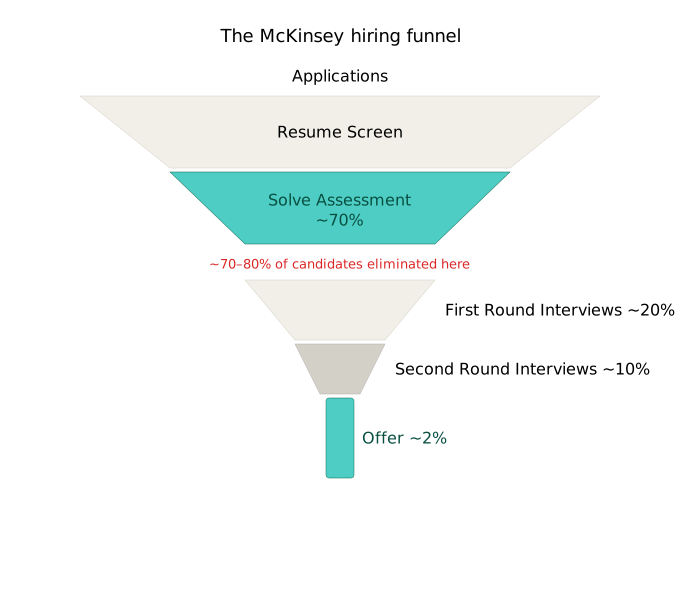
Solve sits after resume screening and eliminates the majority of candidates before interviews.
How Solve is scored
Solve uses percentile scoring. You are not graded against a fixed standard — you are ranked against the global pool of candidates taking the assessment in the same recruiting cycle. A candidate who would have passed comfortably in a weaker cohort might not pass in a stronger one.
McKinsey will tell you your quartile if you request it after completing the test. They will not tell you your exact score, whether you passed, or how far above or below the threshold you landed. You will only find out the result when you receive an interview invitation — or don't — typically 1–2 weeks after completing the assessment.
The estimated passing threshold is the top 20–25% of the candidate pool (roughly the 75th–80th percentile), though this varies by office and role. More competitive offices in high-volume markets tend to have higher effective thresholds.
Your final score combines two components:
- Product score: the quality of your decisions and final outputs in each game
- Process score: the behavioural data generated by how you arrived at those decisions — every click, every hesitation, every reversal
Two candidates can make identical final selections and receive different overall scores because their decision paths diverged. A correct answer reached through erratic trial-and-error scores worse than the same answer reached through a consistent, structured approach. For a detailed breakdown of what the process score tracks and how to optimise for it, see our dedicated article: McKinsey's Behavioural Score Explained.
A note on the process score and Sea Wolf specifically: the process score is significantly more consequential in Redrock than in Sea Wolf, largely due to the nature of the two games. Redrock involves active data collection, note-taking, and navigation between sections — all of which generate rich behavioural signals. Sea Wolf is more constrained in its interface, so the process data it generates is less varied. This doesn't mean you can ignore it in Sea Wolf, but candidates preparing for both games should weight their process score awareness more heavily toward Redrock.
What cognitive skills Solve actually tests
Five cognitive dimensions, translated from academic language into what they actually mean in practice:
Quick, accurate arithmetic. Especially in Redrock. Percentages, ratios, weighted averages, compound growth rates. Nothing exotic — but you need to be fast and accurate under time pressure. Slow mental math is one of the most common causes of failure.
Analytical reading under pressure. Redrock involves processing dense passages and data exhibits quickly and extracting only what's relevant. The skill is not careful literary reading — it's fast, selective extraction.
Working memory. Holding multiple constraints simultaneously while making decisions. Sea Wolf in particular demands this — you're tracking attribute ranges, trait requirements, and pool composition at the same time.
Structured decision-making. Approaching each phase with a consistent framework rather than reacting differently each time. This shows up in both the product score (better decisions) and the process score (better behavioural signals).
Time management. Arguably the most underrated skill in the assessment. Many candidates who understand both games fully still fail because they run out of time. Pacing is a trainable skill.
What Solve does not test: business knowledge, case frameworks, industry expertise, coding ability, or language fluency beyond functional English.
What the current 2026 format looks like
Standard format (most candidates): 2 games, approximately 65 minutes of active game time.
Redrock Study — 35 minutes. A data-heavy research and analysis exercise. You're given a written ecological scenario — for example, the effects of reintroducing a predator species on a forest ecosystem — and must work through three structured stages: investigating the data, performing calculations using an on-screen calculator, and writing a short report. This is followed by six independent mini-cases involving quantitative and logical reasoning. Redrock is the most business-like of the three modules and the most demanding in terms of raw arithmetic speed.
Sea Wolf — 30 minutes. A quantitative optimisation exercise framed as a marine biology task. You visit three contaminated ocean sites and must select combinations of microbes to treat each one, based on their numerical attributes and biological traits. The challenge is finding the combination whose averaged attribute values and trait profile best satisfies the site's requirements — across five phases per site, with a shared 30-minute clock. Phase 4 is scored against five conditions, each worth 20% of that phase score. Sea Wolf tests working memory, numerical reasoning, and time management under pressure.
Extended format (some regions and roles): adds the Sustainable Futures Lab (SFL), approximately 20 additional minutes → ~85 minutes total.
Sustainable Futures Lab (SFL) — ~20 minutes. A newer module currently being rolled out in select regions. It presents a sustainability-focused scenario and evaluates how candidates navigate trade-offs between competing environmental and economic objectives. Less documented than Redrock and Sea Wolf — see our dedicated SFL guide for the most current breakdown of what to expect.
Check your invitation email for the stated duration. If it says 65 minutes, you have Redrock and Sea Wolf. If it says 85 minutes, you'll also face the SFL.
The Ecosystem Building game — the older food-web simulation that appeared in earlier versions of Solve — was phased out globally in mid-2025. If you're using preparation materials that still include Ecosystem Building as a standard module, those materials are out of date.
A few logistics worth knowing:
- Unique scenarios: every candidate receives a randomised version of the assessment. The mechanics are identical but the cosmetic content differs. You cannot memorise answers from other candidates' experiences.
- Untimed tutorials: each game begins with an untimed tutorial. The clock doesn't start until after you finish it. Use the tutorial period to plan your approach — it's the only thinking time you get before the pressure begins.
- Tools allowed: pen and paper, a physical calculator. No external software, no Excel, no AI tools.
- Technical requirements: PC or Mac with at least 8GB RAM, stable internet connection, updated browser. Tablets and phones are not supported. Run the technical check that McKinsey sends with your invitation link before your scheduled slot — not on the day of.
- Scheduling: you'll receive a unique link with your invitation. That link walks you through a tech diagnostic, then lets you book a specific time slot. The clock starts when you begin the assessment during your booked slot, not when you open the link.
A brief history of McKinsey Solve
Understanding where Solve came from helps explain why it works the way it does.
Before 2019: McKinsey used the Problem Solving Test (PST) — a traditional timed multiple-choice exam testing business reasoning and arithmetic. Effective but gameable through memorisation and rote practice.
2019–2022: McKinsey partnered with Imbellus (a cognitive assessment company later acquired by Roblox in 2021) to develop a gamified replacement. The early Solve included several nature-themed simulation modules: Ecosystem Building, Plant Defense, and others. Rollout was gradual.
2022–2024: Redrock Study introduced as the primary analytical module, replacing or supplementing the older games. Ecosystem Building remained standard.
Mid-2024: Sea Wolf pilots globally as a new module.
Mid-2025: Ecosystem Building phased out globally. Sea Wolf becomes standard. Format stabilises at 2 games, 65 minutes.
2026: Current stable format — Redrock + Sea Wolf, with SFL appearing in select regions and roles.
The reason McKinsey moved away from the PST isn't hard to understand: a multiple-choice test can be prepared for in ways that inflate scores without improving the underlying skills McKinsey wants. Solve's process score makes it significantly harder to game — arriving at the right answer through memorised patterns looks different in the telemetry from arriving there through genuine reasoning.
What comes after Solve
Pass Solve and the process continues as follows:
- Optional recruiter screen (15–20 minutes): a brief call to confirm basics and walk you through next steps. Mostly logistical. Not evaluative for most candidates.
- First round interviews (2 interviews, 45–60 min each): conducted by engagement managers or junior partners. Each interview includes a case interview and a Personal Experience Interview (PEI). This is where the majority of remaining candidates are cut.
- Final round interviews (2–3 interviews): conducted by senior partners. More discussion-based, less structured than first round. Cultural fit is weighted more heavily here.
- Offer decision: typically within 1–5 business days of the final round.
Full timeline from application to offer is typically 4–8 weeks, though this varies significantly by office and recruiting season.
One important clarification: your Solve result does not carry forward into the interview rounds. It is a gate, not a grade. Once you're through it, what happened in Solve is irrelevant — interview performance is all that counts from that point on. Case interview preparation is a completely separate skill set that requires its own dedicated preparation.
How to prepare
The cognitive skills Solve tests are genuinely improvable. Here's what preparation looks like in practice:
Mental arithmetic. The single most universally useful thing to drill before Solve. Focus on: percentages (calculating X% of Y quickly), ratios and proportions, weighted averages, and rough compound growth estimates. These come up constantly in Redrock and inform Sea Wolf decisions too.
Fast reading and data extraction. Practice reading dense passages and charts with the goal of pulling out only the relevant figure as quickly as possible. This is different from careful reading — it's triage.
Simulator practice. Familiarity with the interface is a genuine performance factor. Candidates who've played through realistic Redrock and Sea Wolf scenarios before test day don't waste cognitive bandwidth figuring out how the interface works — they spend it on the actual decisions. At minimum, do several full end-to-end runs under time pressure before your scheduled slot.
Full-length practice runs. Don't practise the games in isolation. Run the full 65-minute session — Redrock then Sea Wolf — to build stamina and pacing. The fatigue from 35 minutes of Redrock is real, and Sea Wolf performance typically drops for candidates who haven't prepared for the combined duration.
Related guides
- The McKinsey Sea Wolf Game — complete 2026 guide
- McKinsey Redrock Study — phases, scoring, and strategy
- McKinsey Sustainable Futures Lab — what to expect
- McKinsey's behavioural score explained
- McKinsey Solve 2026 — what's changed and what to expect
- Sea Wolf strategy guide — optimal play for each phase (simulator access required)